We use cookies on this site to enhance your user experience
By clicking the Accept button, you agree to us doing so. More info on our cookie policy
We use cookies on this site to enhance your user experience
By clicking the Accept button, you agree to us doing so. More info on our cookie policy
Northern lights recorded over Central Europe during a strong geomagnetic storm
Published: Jan 24, 2026 by Roman Dvořák
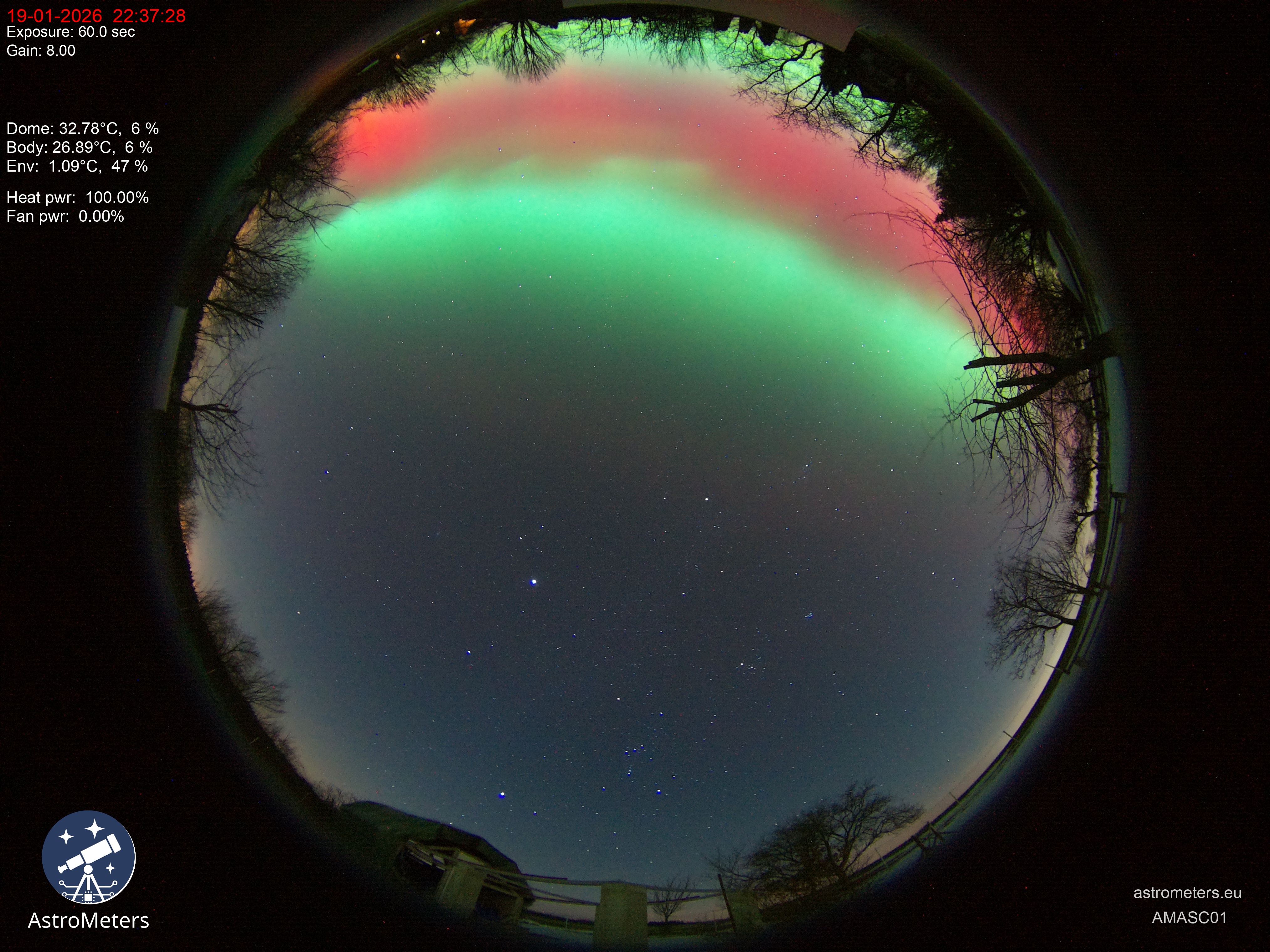
On the night of 19 January 2026, a strong geomagnetic storm produced a spectacular aurora borealis visible across much of Europe, including the Czech Republic. This northern lights event was recorded by the AMASC01 all-sky camera, a wide-field astronomical camera developed by AstroMeters for continuous night-sky monitoring.
The aurora appeared above the northern horizon shortly after 22:30 CET, forming a broad arc with distinct green and red auroral structures visible across the sky. Because strong auroras are relatively rare at this latitude, the event is a useful example of how an all-sky camera can document transient space-weather phenomena over Central Europe.
The full-night recording is available on YouTube: AMASC01 all-night aurora timelapse from 19 January 2026
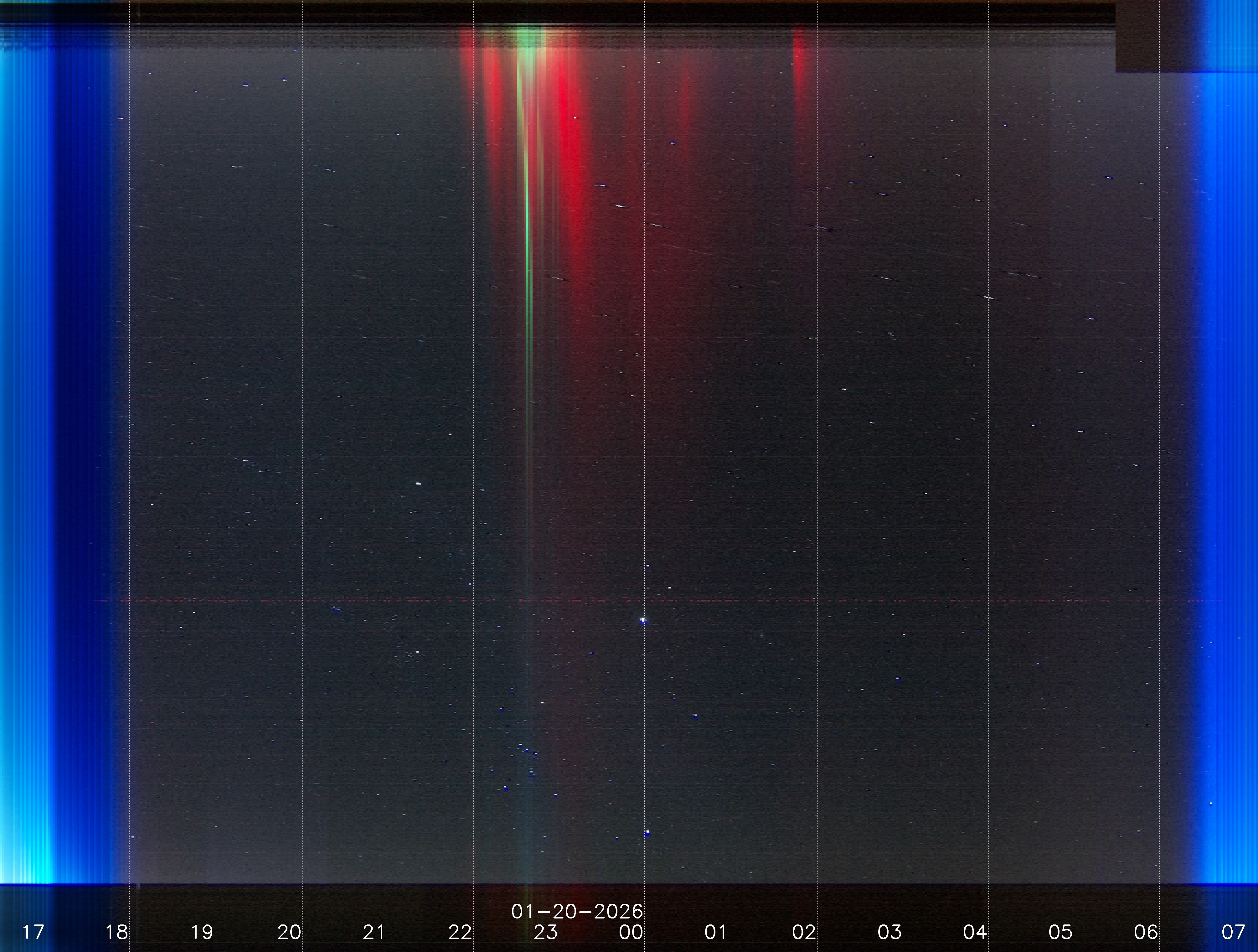
The keogram below shows the temporal evolution of the aurora event and helps identify the onset, peak activity, and fading phase of the northern lights during the night.
The aurora was triggered by a powerful X1.9-class solar flare that erupted on 18 January 2026 from an active region on the Sun. The flare produced a fast coronal mass ejection (CME) directed toward Earth.
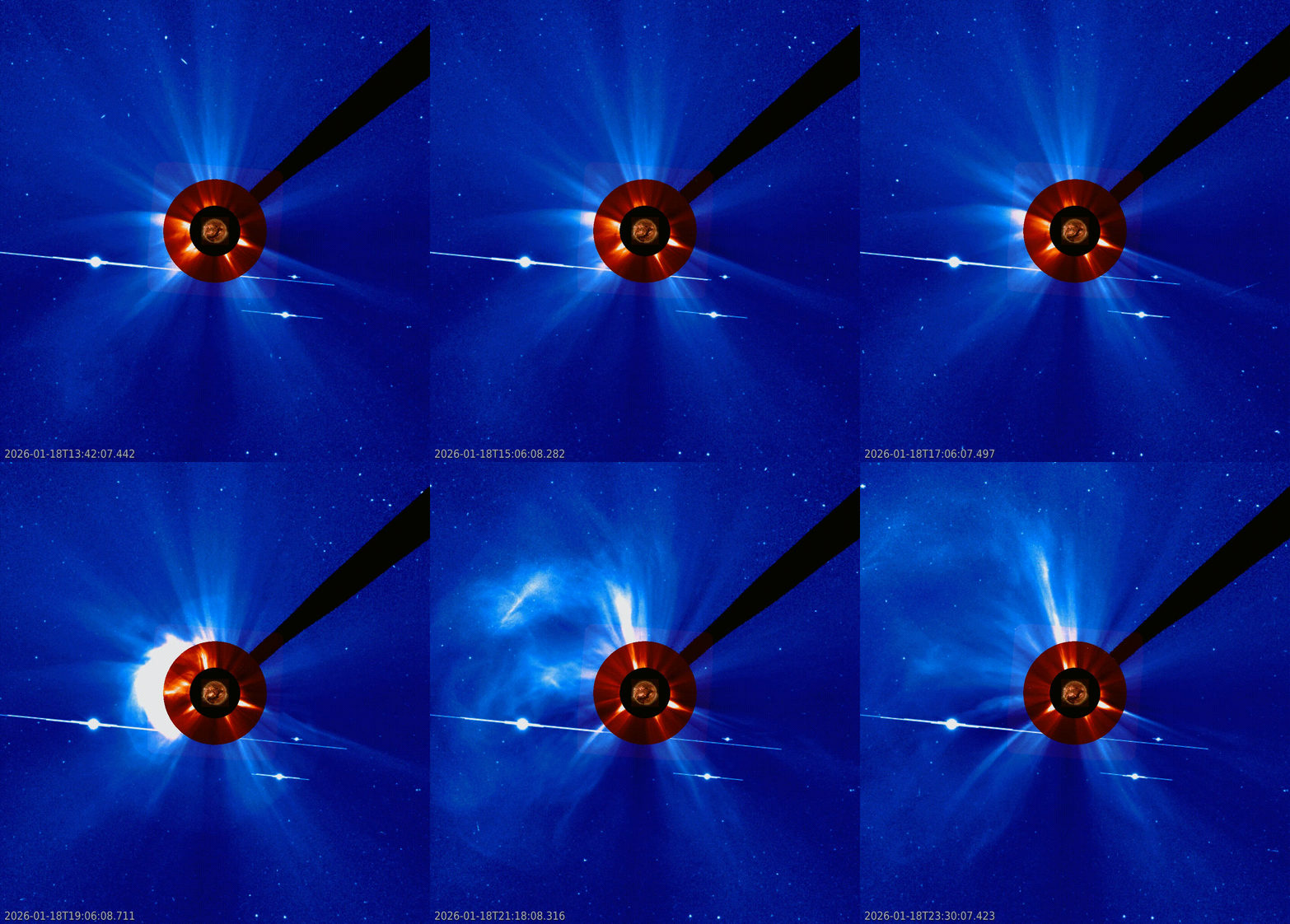
CME animation. Credits: ESA/NASA (SOHO) & NASA (SDO)
When the CME reached Earth about a day later, it triggered a strong geomagnetic storm (G4). During such events, the auroral oval expands toward lower latitudes, allowing auroras to be observed far outside the polar regions, including across Central Europe and the Czech Republic.
As a result, the aurora was visible in many Central European countries including Germany, Austria, Poland, and the Czech Republic, where it appeared as red and green arcs above the northern horizon.
The geomagnetic activity was so extensive that the aurora was still visible from the Czech Republic on the following night, 20 January 2026. It was noticeably weaker than on the main event night, and only its red component was visible.
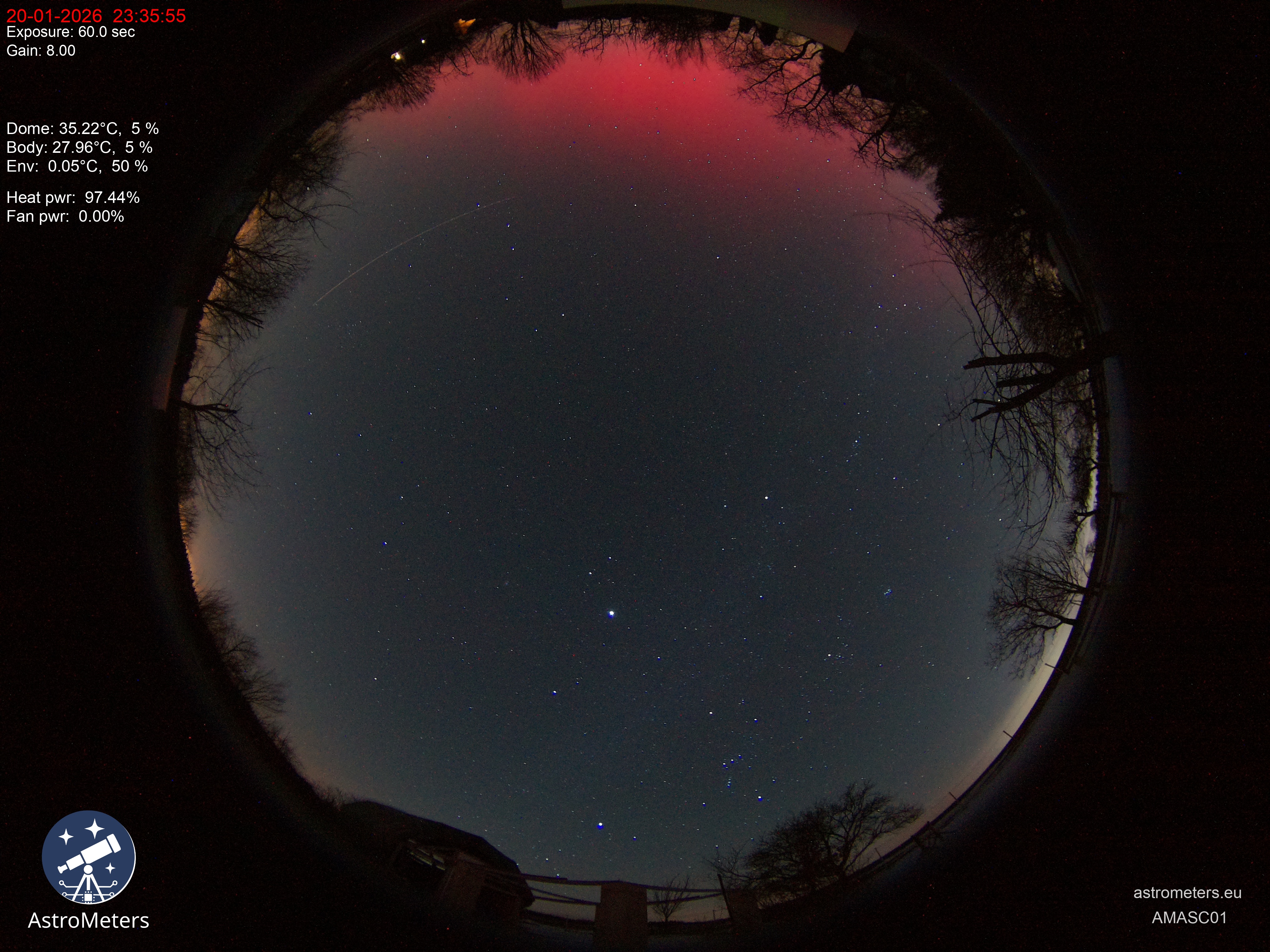
Follow-up observation from the next night, showing only the weaker red auroral component.
The AMASC01 all-sky camera is a fish-eye all-sky camera designed for continuous monitoring of the night sky. Using a fisheye optical system, it captures the entire sky dome and allows long-term recording of transient atmospheric and astronomical phenomena.
Such cameras are particularly useful for documenting events such as:
The aurora recorded on 19 January 2026 demonstrates the capability of the AMASC01 all-sky camera to document rare atmospheric phenomena visible across the whole sky, including aurora borealis events in Central Europe.
More information about the camera and other astronomical instruments is available on the AstroMeters website.
Share