We use cookies on this site to enhance your user experience
By clicking the Accept button, you agree to us doing so. More info on our cookie policy
We use cookies on this site to enhance your user experience
By clicking the Accept button, you agree to us doing so. More info on our cookie policy
All-sky view of the Moon's shadow for the Planetum live stream
Published: Sep 24, 2026 by Roman Dvořák
On 12 August 2026, a total solar eclipse crossed the Iberian Peninsula. The AMASC01 all-sky camera was part of the equipment at our observing site near the village of Mecerreyes in the Sierra de las Mamblas highlands, helping to deliver the live eclipse broadcast prepared by Planetum.
Time-lapse from AMASC01 frames taken every 20 seconds between 20:15 and 20:45 CEST.
You can see how the Moon’s shadow passed over the observing site in Spain in the animation above.
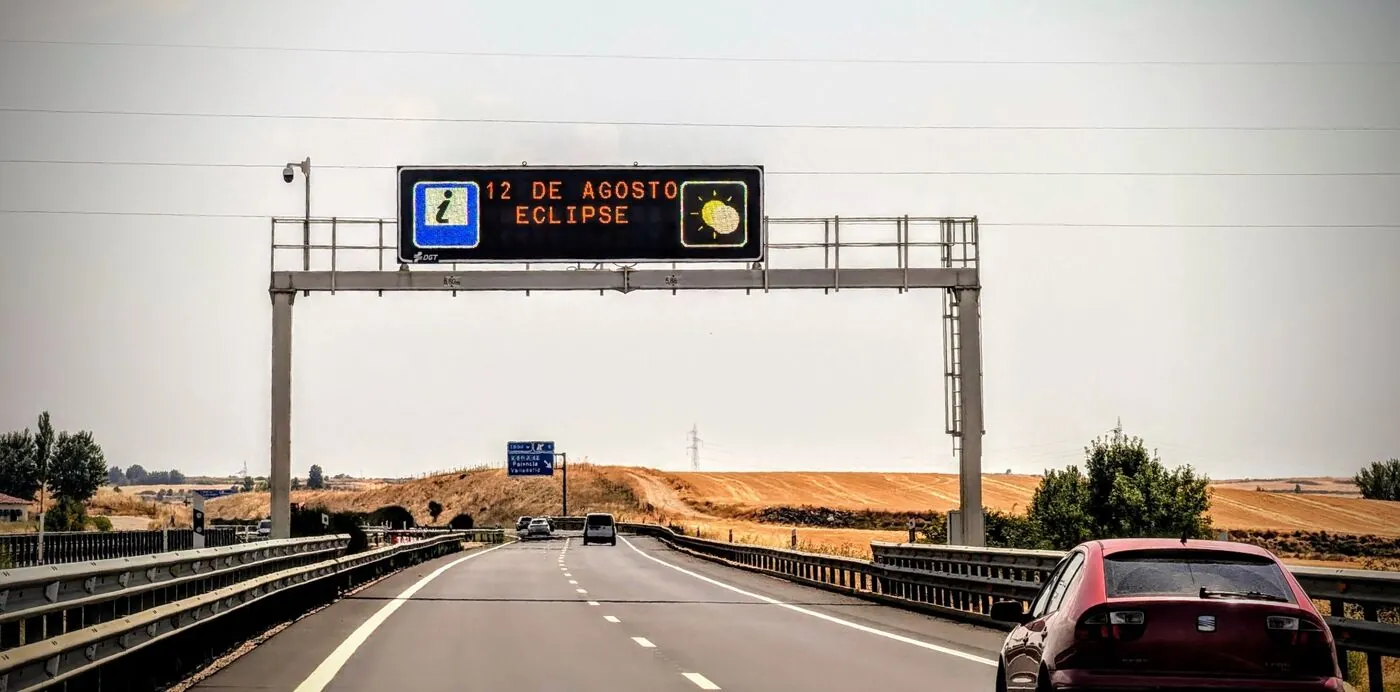
The eclipse was hard to miss in Spain – even the highway information signs were counting down to 12 August.
The frame below was taken during totality. The sky above the site is dark, while the horizon all around glows in pink and orange – this is sunlight scattered in the atmosphere outside the Moon’s shadow. The whole extent of the shadow is visible at once, which is something only a fisheye all-sky camera can capture in a single image.
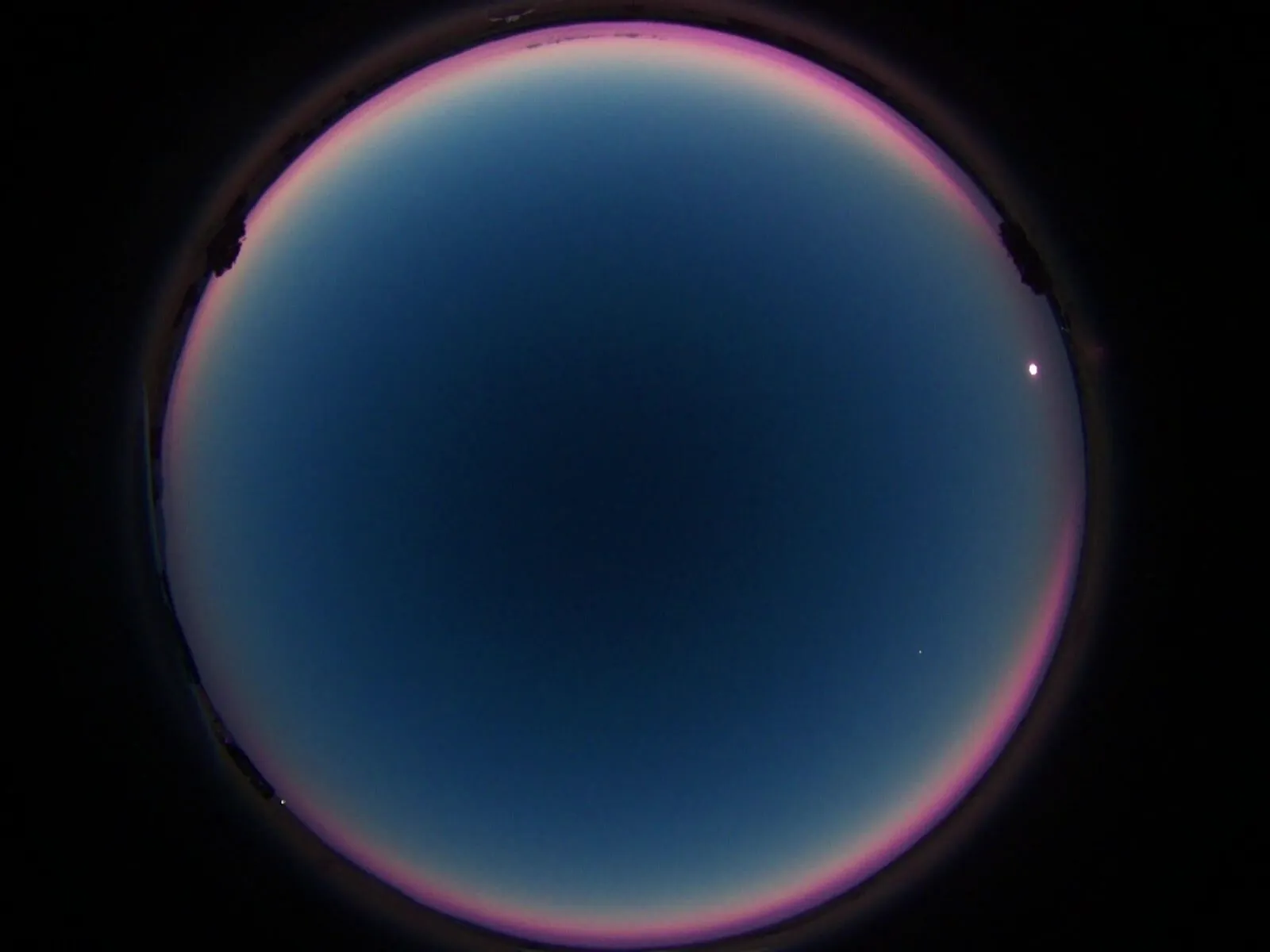
AMASC01 frame during totality (20:30 CEST) – the darkened sky inside the Moon's shadow surrounded by the bright twilight-like ring near the horizon.
The stream was shown live on the large LED wall in the foyer of Planetum’s state-of-the-art Prague Planetarium and at the Žebrák Observatory, and it was also broadcast publicly on YouTube. The recording below starts at the part of the stream where the live feed from the AMASC01 all-sky camera was shown:
All measuring instruments needed for the expedition were mounted on the car as much as possible. This made it possible to relocate quickly if the weather required it, and it also greatly shortened unpacking and preparation on site.
Part of the preparation took place directly at our accommodation in Spain, so a set of tools – drill, bits and hex keys – was an essential part of the luggage.
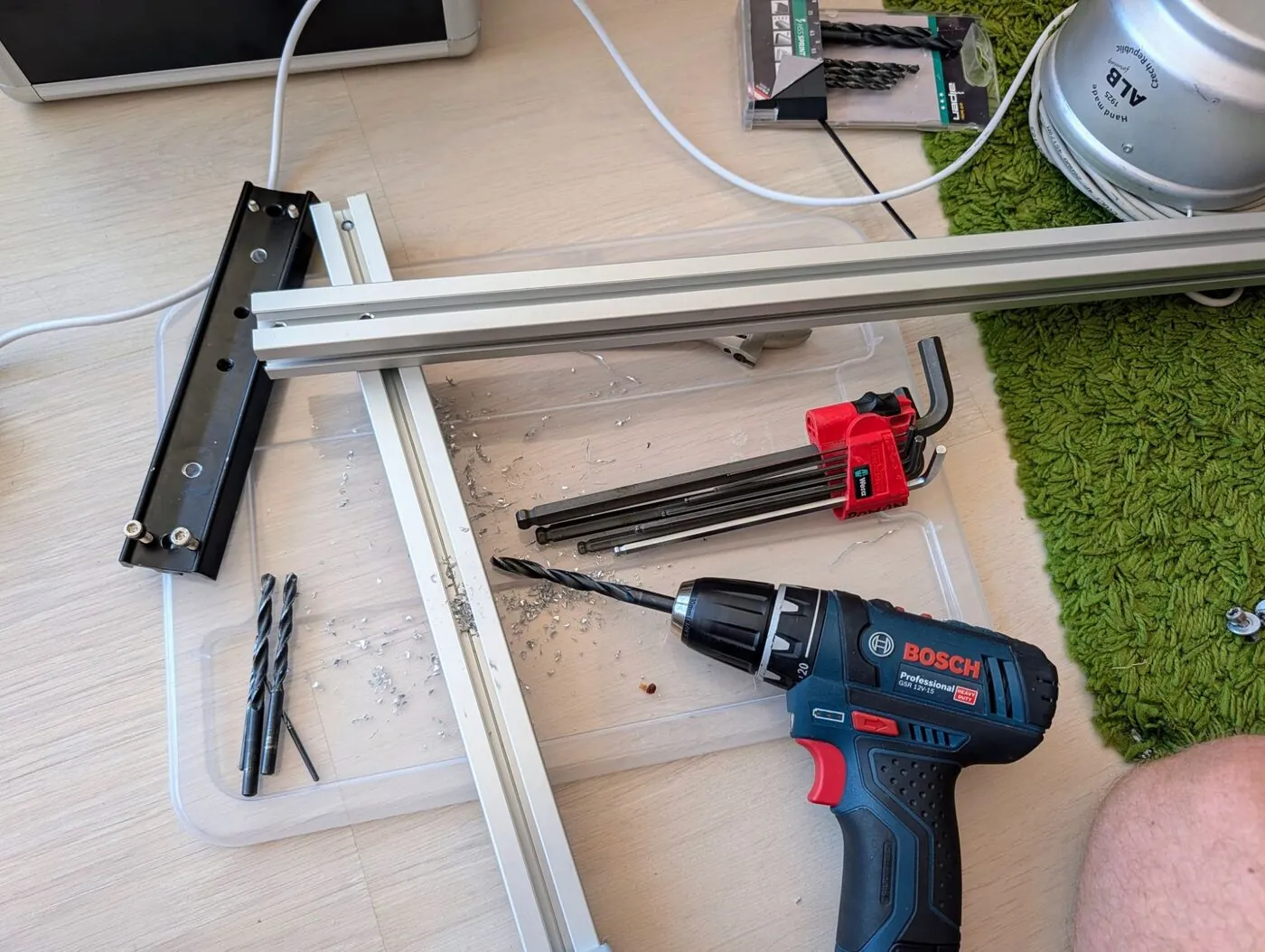
Finishing the roof rack for the instruments at the accommodation in Spain.
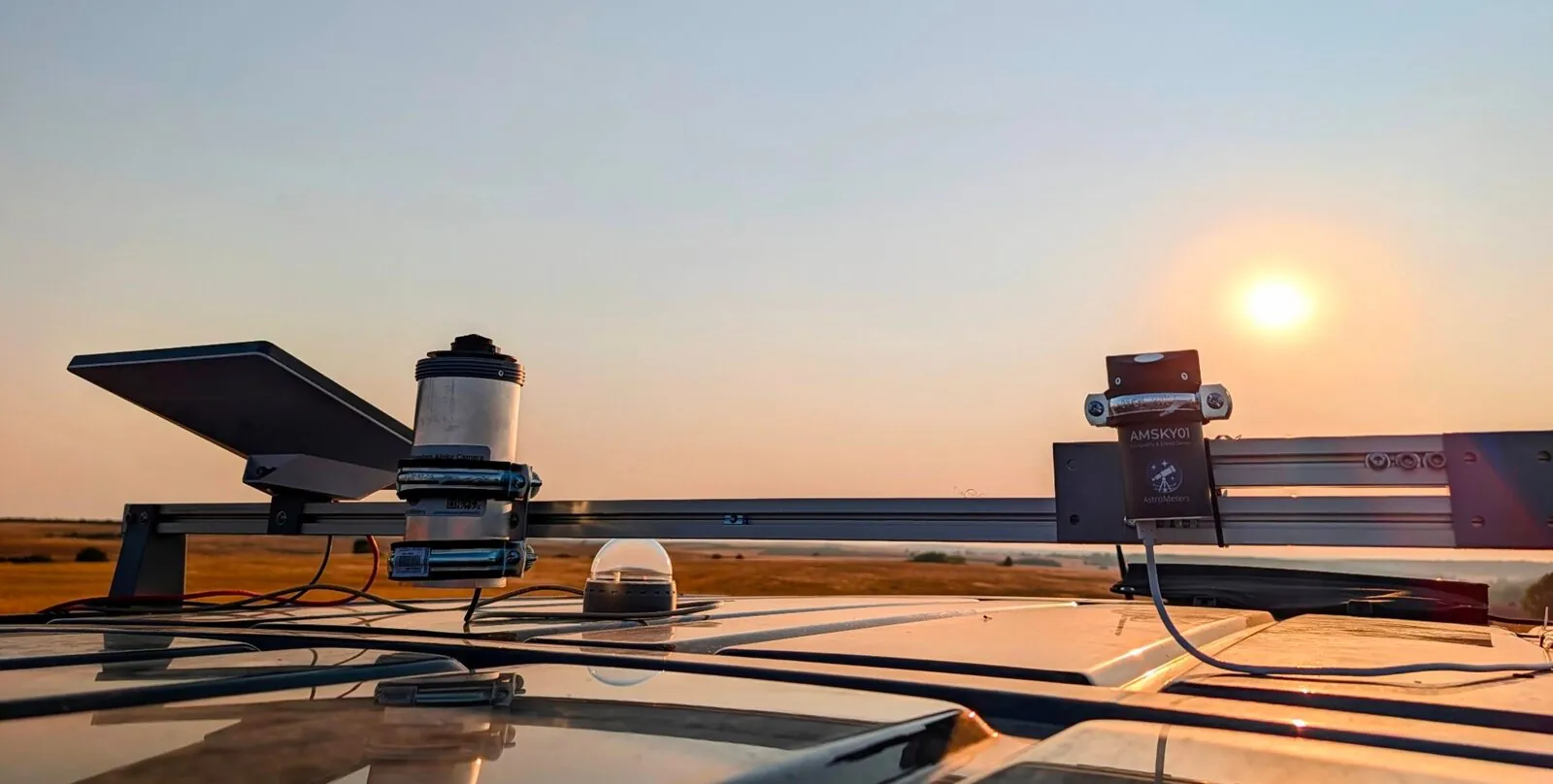
Starlink Mini terminal, AMASC01 all-sky camera and AMSKY02 cloud sensor (from left) mounted on the roof rack.
The following instruments were used for the stream and observation:
We wanted to choose the observing site according to the weather conditions, not according to mobile signal coverage. For this broadcast we therefore borrowed a Starlink Mini terminal, which provided a very good connection throughout the whole event. The only small drawback was that it did not work while driving – not even when mounted outside on the roof.
In the end, the site we chose turned out to have a very good 5G signal. The same, however, cannot be said about many other places in Spain.
The whole broadcast was controlled from a mobile control desk inside the car.
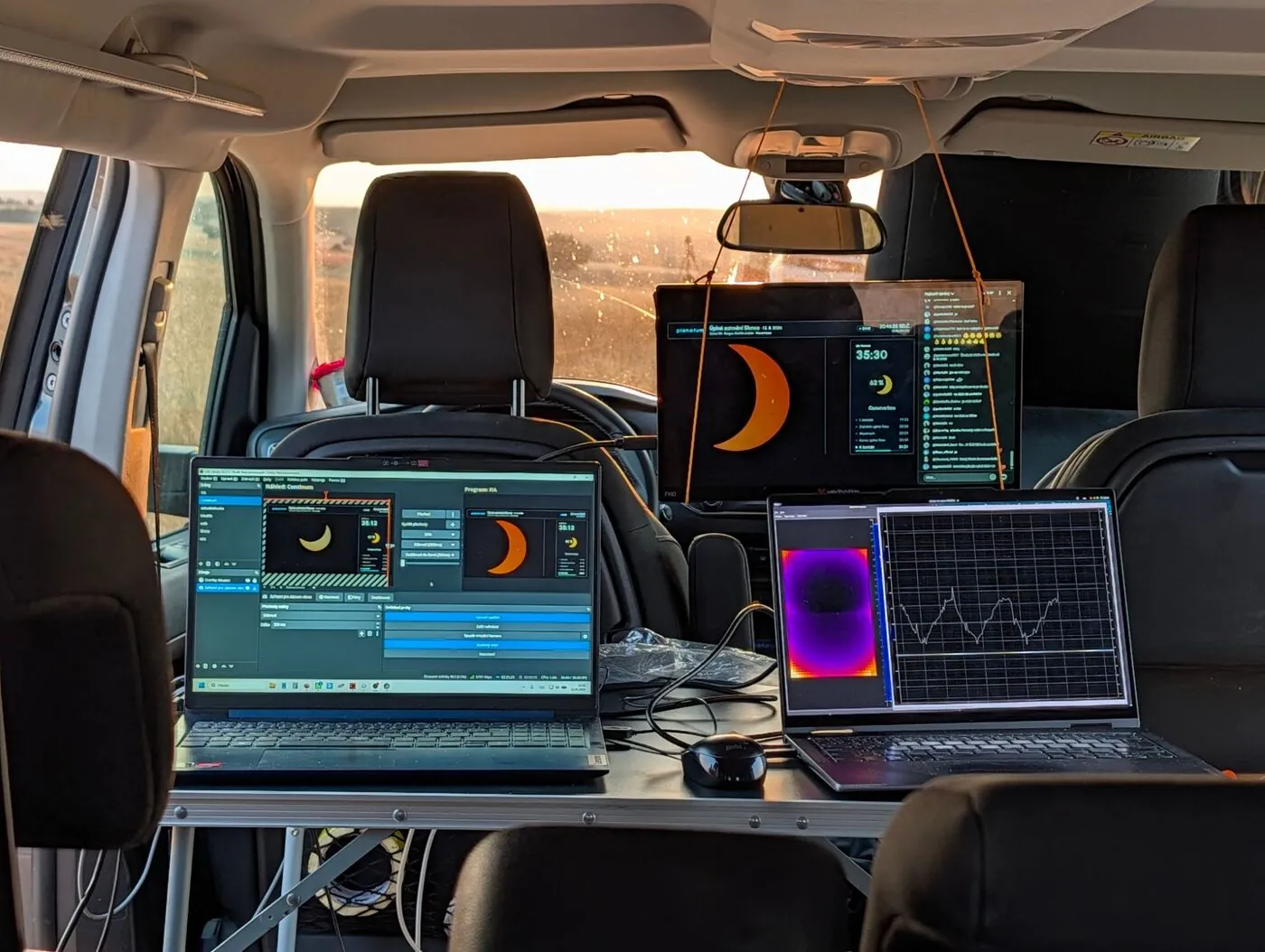
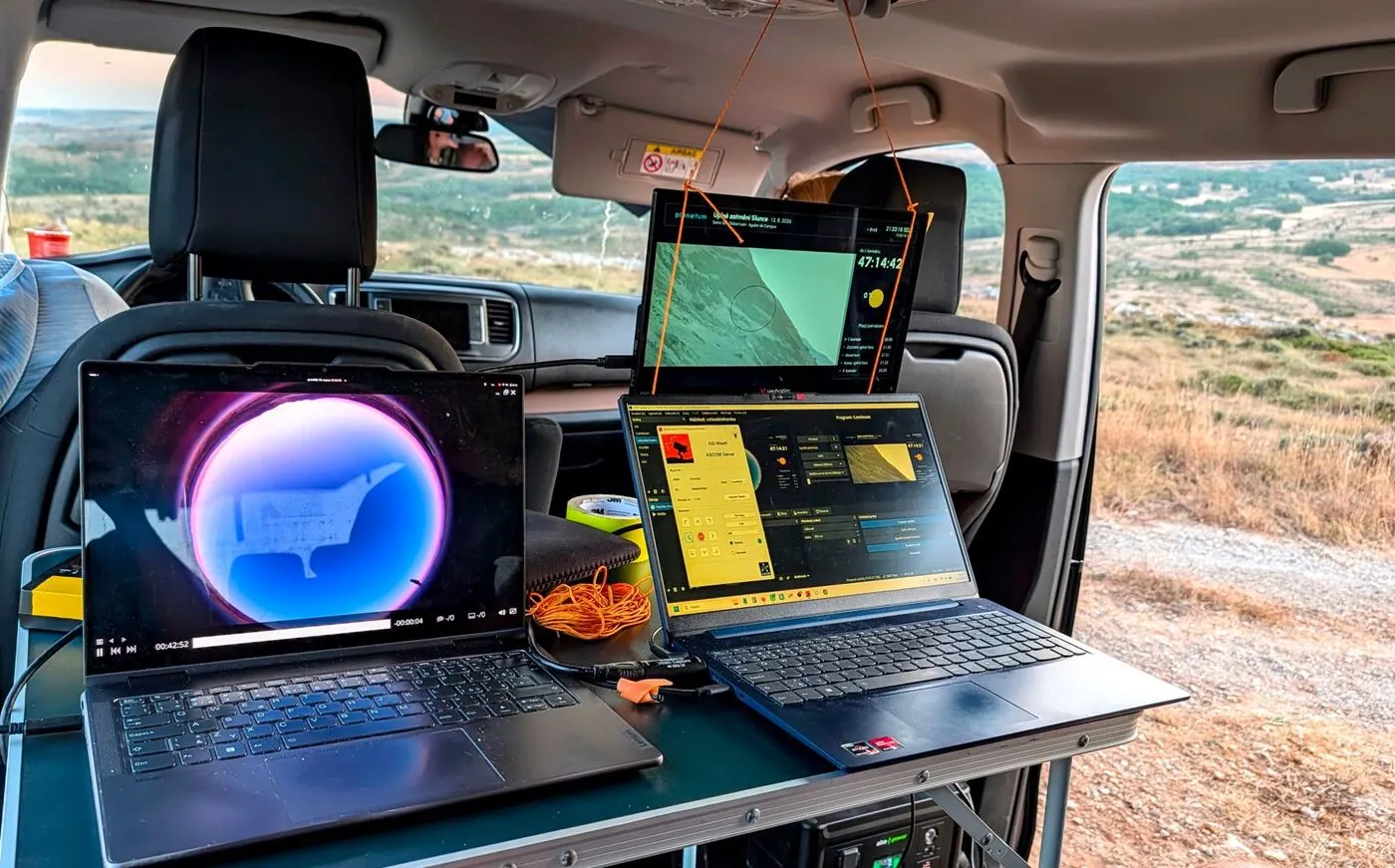
During the eclipse, AMASC01 had two tasks running at the same time.
The camera provided a continuous RTSP video stream of the whole sky. The stream was brought into OBS and used as one of the broadcast sources – for example at moments when the feed from the telescopes had to be interrupted. Viewers could then still follow the sky above the observing site, including the approaching darkness and the changing colours of the horizon.
In parallel with the stream, the camera saved a full-resolution frame every 20 seconds. Because this was my first total eclipse, I expected 20 seconds to be a comfortable interval. In the end it turned out to be rather the lower limit for the event itself – the passage of the shadow and totality happen so fast that a shorter interval would capture noticeably more detail. The time-lapse at the top of this article was assembled from these frames.
The broadcast was followed live both in the foyer of the Prague Planetarium and at the Žebrák Observatory:
The AMASC01 all-sky camera is designed for continuous, round-the-clock monitoring of the whole sky. Besides night-time applications such as aurora, meteors and cloud monitoring, it can also document daytime events such as solar eclipses – and, as this event showed, provide a live all-sky video feed for public broadcasts.
More information about the camera and other astronomical instruments is available on the AstroMeters website.
Share