We use cookies on this site to enhance your user experience
By clicking the Accept button, you agree to us doing so. More info on our cookie policy
We use cookies on this site to enhance your user experience
By clicking the Accept button, you agree to us doing so. More info on our cookie policy
All-in-one Sky Quality, Cloud & Environment Sensor
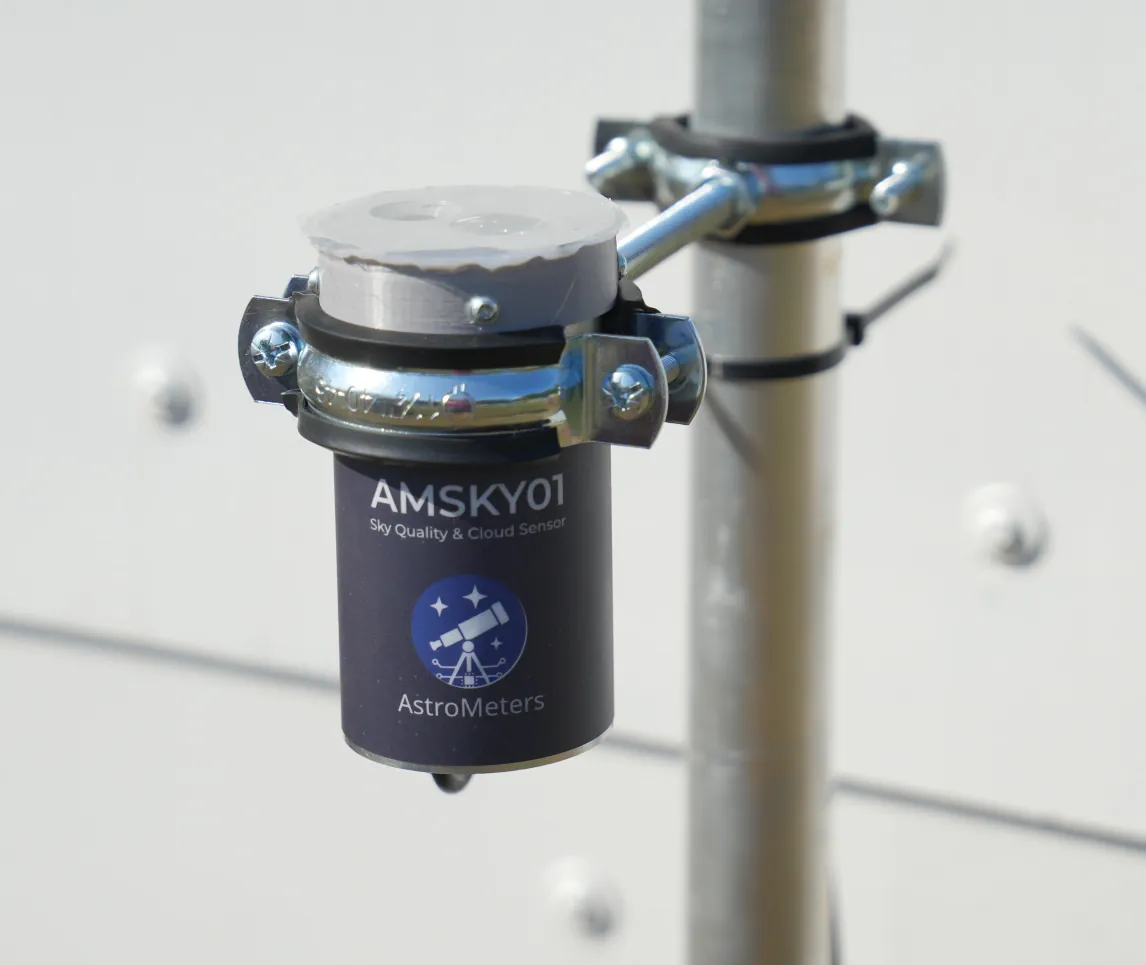
AMSKY01
All-in-one Sky Quality, Cloud & Environment Sensor
224 EUR
AMSKY01
Sky brightness sensor with mag/arcsec² output
Infrared cloud detection sensor
Precision temperature & humidity sensor
Dual interface USB-C & RS485
ASCII protocol for easy integration
Designed for autonomous observatories
Description
A newer version is available: AMSKY02 features dual SQM sensors, a high-resolution pixel thermopile array, and an improved water-pooling resistant enclosure.
AMSKY01 is a versatile, all-in-one sensor for astronomers and observatories. It measures sky brightness, detects cloud coverage using advanced sky temperature measurement, and provides ambient temperature and humidity readings.
With both USB (CDC serial) and RS485 interfaces, AMSKY01 can be easily connected to computers, automation controllers, or building management systems. Designed for permanent installations, AMSKY01 delivers all essential environmental data for night sky observation, light pollution monitoring, and observatory automation — in a single, robust device.
Sky Brightness Measurement Real-time readings in magnitudes per square arcsecond (mag/arcsec²) for objective light pollution assessment.
Cloud Coverage Detection Dedicated sky temperature sensor (thermal IR) for fast cloud presence and sky clarity evaluation.
Ambient Temperature & Humidity High-accuracy, calibrated sensors monitor local environmental conditions.
Dual Interface: USB & RS485 Plug-and-play via USB-C (CDC serial) for computers, or RS485 for direct integration with observatory or building automation systems (BMS/SCADA).
Open Protocol & API Fully documented for custom integration and automation.
Weatherproof & Durable Rugged enclosure for outdoor and permanent installations.