We use cookies on this site to enhance your user experience

By clicking the Accept button, you agree to us doing so. More info on our cookie policy

AMSKY02 – Sky Quality and Cloud Sensor

AMSKY02: Dual-sensor sky quality and cloud sensor

AMSKY02 – Sky Quality and Cloud Sensor

The AMSKY02 is a compact, weatherproof sky sensor designed for astronomical and environmental applications. It combines multiple sensors in one unit:
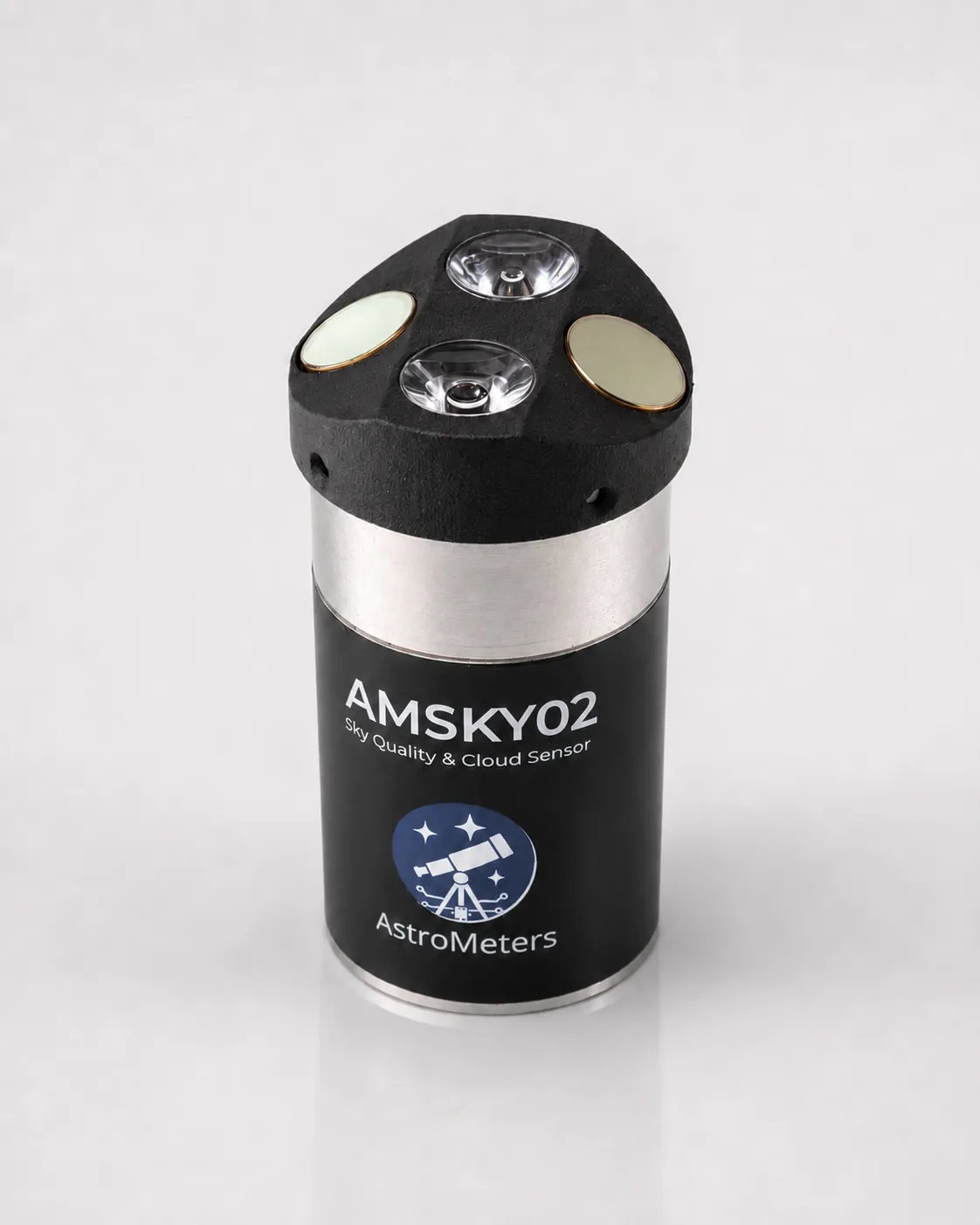
  • Dual sky brightness sensors (SQM) – 10° and 60° field of view, measuring sky brightness in mag/arcsec².
  • 32×24 pixel infrared cloud sensor – dual thermopile array for detailed sky temperature mapping (64×48 variant available).
  • Water-pooling resistant design – sensor head geometry prevents water accumulation on optical surfaces.
  • Temperature and humidity sensor – SHT41, monitors ambient air conditions.
  • USB-C and RS-485 interfaces – for easy connection to PCs or automation systems.

AMSKY02 sensor

Note: AMSKY02 is the successor to the original AMSKY01. Key improvements include dual SQM sensors (instead of a single one), a pair of IR thermopile arrays with redesigned mounting that doubles the resolution and field of view compared to AMSKY01, and an improved water-pooling resistant enclosure. Both models share the same software, protocol, and interfaces — the amsky01 Python package and INDI driver work with both.

Live Cloud Detection Example

The following video demonstrates real-time data from the AMSKY sensor as clouds pass through its field of view. The dual thermopile array with 32×24 pixel combined resolution provides detailed sky temperature mapping with 150°×110° field of view, allowing precise tracking of cloud coverage and movement patterns.

How the Pixel Sensor Works

The infrared cloud sensor is based on a dual thermopile array with 32×24 pixel combined resolution (64×48 variant available), acting like a low-resolution thermal camera for the sky.
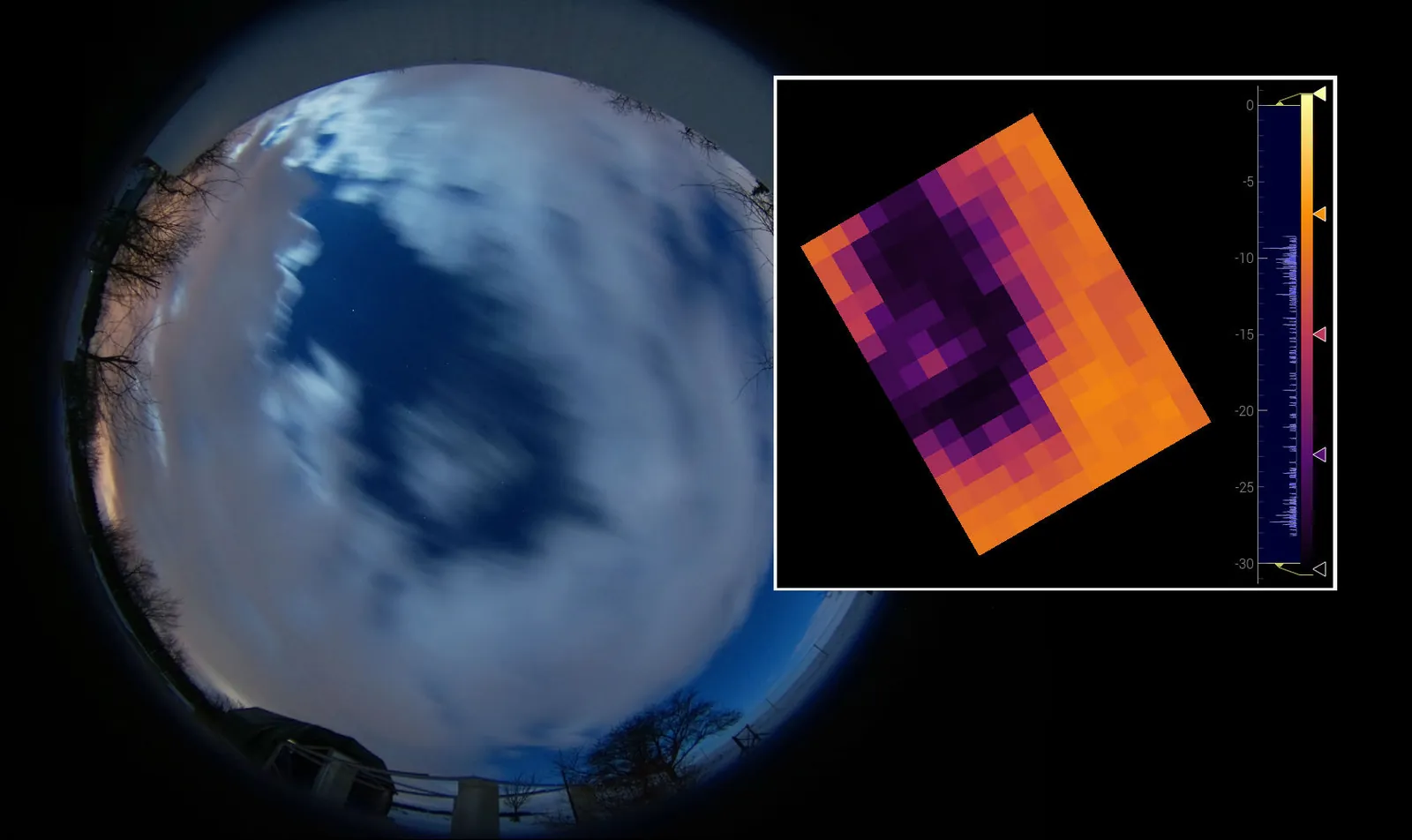
AMSKY cloud visualization

Comparison of an optical image of the night sky with clouds from the AMASC01 allsky camera and the AMSKY thermopile pixel sensor.

Benefits of a pixel sensor:

  • Spatial cloud detection: See not only if clouds are present, but exactly where and how many.
  • Accurate sky background: By averaging only the coldest pixels, the device can minimize the influence of warm objects (trees, chimneys, buildings) at the edge of the field of view.
  • Robust automation: Algorithms can ignore local obstructions and focus on clear-sky regions, improving reliability for observatory control.
  • Real-time visualization: Instantly visualize cloud structure and movement on the included GUI or in your own analysis scripts.

Key Features

  • Real-time sky quality measurements (SQM) to assess light pollution.
  • Fast and reliable cloud detection using infrared sky temperature.
  • Accurate ambient temperature and humidity monitoring.
  • USB-C (CDC Serial) interface for plug-and-play operation with computers.
  • RS-485 interface for integration with observatory or building automation.
  • Open protocol and API documentation for custom applications.
  • Designed for continuous outdoor use in observatory conditions.

Applications

  • Light pollution monitoring.
  • Automatic observatory control (e.g., dome closure during clouds).
  • Weather condition logging for astronomical sites.
  • Networked sky sensor systems and citizen science projects.
  • Environmental data collection and automation.

Technical Specifications

Parameter AMSKY01 AMSKY02
Cloud detection Thermopile array 16×12 px
75°×110° FoV
Dual thermopile array 32×24 px
150°×110° FoV
High-res variant: 64×48 px available
Sky brightness (SQM) Single sensor (10° or 60° FoV, selectable) Dual sensor: 10° and 60° FoV
mag/arcsec²
Temperature −15 °C to +50 °C −30 °C to +70 °C
Humidity Relative humidity sensor
Interfaces USB-C (CDC serial), RS-485
Power supply USB bus power or external 8–13 V DC
Ingress protection IP53W

Interfaces

USB-C (CDC Serial)

  • Virtual serial port communication.
  • Outputs real-time sensor data in ASCII or structured format.

RS-485

  • Industrial interface for robust long-distance communication.
  • Suitable for integration into SCADA or observatory control systems.

Communication Protocol

  • Open protocol with documented commands and responses.
  • Available API and example code for integration.