We use cookies on this site to enhance your user experience
By clicking the Accept button, you agree to us doing so. More info on our cookie policy
We use cookies on this site to enhance your user experience
By clicking the Accept button, you agree to us doing so. More info on our cookie policy
AMASC01: Circle Buffer Capture
The Circle Buffer Capture mode is intended for situations where the priority is not continuous all-night imaging, but capturing very fast transient events at the highest frame rate the camera can reliably deliver.
This software is based on CircularPiCam, a capture pipeline designed for high-speed event recording with RAM-based circular buffering and trigger-controlled clip saving.
The following video was captured using an AMASC01 prototype equipped with an alternative optical chip capable of 60 FPS. The recording is slowed down and shows a lightning discharge.
This mode has the opposite design goal compared to the standard Base Software Stack, which is built around continuous all-sky monitoring, long-term operation, and regular image generation.
Circle Buffer Capture focuses instead on:
This makes it suitable for phenomena that happen too quickly for standard periodic all-sky imaging.
Note: This software was originally developed specifically for the AMASC01 platform and for monitoring the development of bolides and other very fast luminous events in the sky. At the same time, it is designed as a more universal capture system and can also be used with optics with a narrower field of view, with other camera configurations, or in application-specific trigger and recording setups. For more information about suitable configurations or possible adaptations, please do not hesitate to contact us for consultation.
On request, the AMASC01 can be equipped with a Sony IMX296 sensor in either:
The Sony IMX296 uses a global shutter and supports frame rates of up to 60 FPS, which is important for capturing very fast events without rolling-shutter distortion.
The software continuously stores recent image data in a RAM-based circular buffer. This means the system always keeps the most recent seconds of recording in memory, even before any trigger occurs.
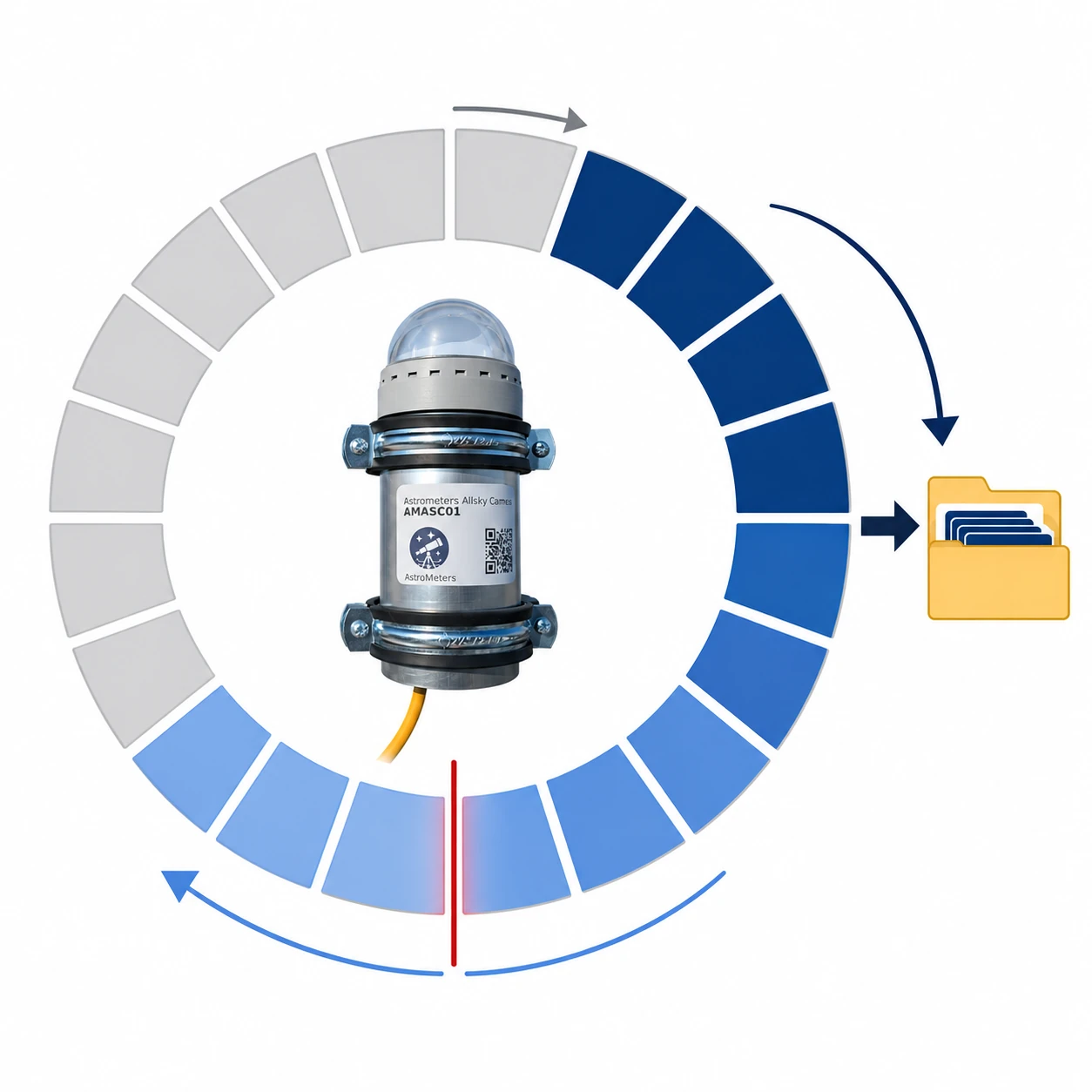
Circular buffer principle showing continuous frame rotation, trigger point, and clip export with preserved pre-trigger and post-trigger history.
When a trigger is received, the software saves:
This allows the user to record not only the event, but also what happened immediately before it.
Several trigger methods can be used depending on the application:
These trigger modes allow the camera to react to external systems, sudden scene changes, or direct operator input.
Circle Buffer Capture is useful for events that are brief, unpredictable, or scientifically interesting only when the full pre-event context is preserved.
Example use cases include:
In all of these scenarios, the ability to preserve frames from before the event is often more valuable than continuous low-rate imaging.
Note: This software is also open-source. If you are interested in this capture mode or want to discuss a custom configuration, please use the contact information in the About section.